

Full-stack agents
Genkit agents package the model loop, message history, tool calls, streaming, and persistence behind one API. You define the agent on the server, then call the same conversational interface in process or through HTTP.
Genkit agents are useful when your app needs an assistant, an approval workflow, a long-running generator, or a coordinator that delegates work to specialized agents. They build on Genkit prompts and generate() calls, so they can use models, tools, middleware, and developer tooling from the rest of Genkit.
When to choose Genkit agents
Section titled “When to choose Genkit agents”Use standard Genkit flows and generate() primitives when you want full control over the application’s API shape, persistence model, orchestration, and frontend protocol. A flow is often the right fit for request and response tasks, explicit backend workflows, scheduled jobs, and systems where your app already owns every step of state management.
Use Genkit agents when the feature is naturally conversational or iterative. They handle the repeated work that chat-based applications need, including message history, streaming updates, tool turns, snapshots, aborts, interrupts, background execution, and continuation from a previous turn. They are a strong fit for persistent chat applications, conversational product experiences, approval workflows, task copilots, and multi-turn generation where the model refines output over several steps.
Genkit agents are also designed for seamless frontend integration. A browser or mobile client can use the same chat() interface for local and remote agents, receive streamed text, state patches, artifacts, and tool interruptions, then continue the next turn without rebuilding the transport protocol. You can build the same capabilities with flows and generate() if you need maximum architectural control, but agents remove much of the plumbing for persistent, interactive AI features.
The Agents API is available in Genkit Dart. It supports local agents, server-managed session stores, HTTP shelf serving, custom state, tool interrupts, background detached work, and remote agent clients.
Your first agent
Section titled “Your first agent”import 'package:genkit/genkit.dart';import 'package:genkit_google_genai/genkit_google_genai.dart';
final ai = Genkit( plugins: [googleAI()], model: googleAI.gemini('gemini-flash-latest'),);
final assistant = ai.defineAgent( name: 'assistant', system: 'You are a helpful assistant.',);
void main() async { final chat = assistant.chat(); final res = await chat.send(text: 'Hello. What can you do?');
print(res.text);}Common path
Section titled “Common path”Most production agents grow in this order:
- Define the agent with a model, system instructions, and tools.
- Call it locally with
chat.send()orchat.sendStream(). - Add a session store (
InMemorySessionStoreorFileSessionStore) when the server should own history. - Serve it over HTTP with shelf routes using
shelfHandlerfor the agent turn, snapshot, and abort actions. - Call the agent from a remote client using
remoteAgent().
Develop with the Genkit Dev UI
Section titled “Develop with the Genkit Dev UI”The Genkit Developer UI lets you chat with your agents, inspect their full execution, and iterate quickly without writing any frontend code. When you run your app with the Genkit CLI, agents appear alongside your flows, prompts, and models so you can send messages, watch streamed responses, step through tool calls, and review session state.
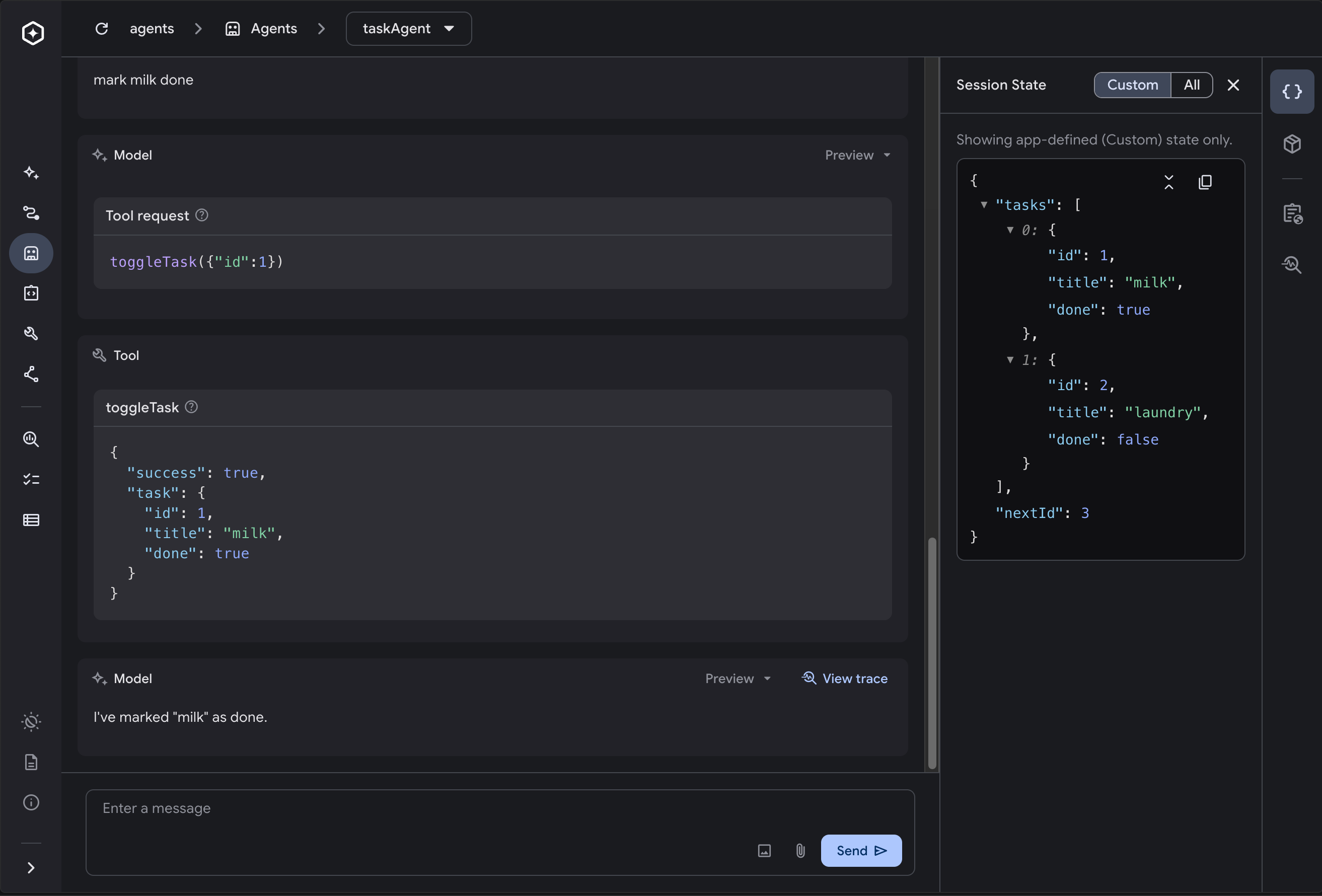
This makes the Dev UI a fast way to test conversational behavior, debug tool turns, and verify interrupts and continuation before wiring up a client. You can also inspect detailed execution traces for each turn to see model calls, tool invocations, latency, and token usage.
Where to go next
Section titled “Where to go next”- Define agents covers
defineAgent,defineCustomAgent, tools, and schemas. - Run and stream covers
chat(),loadChat(),send,sendStream, andAgentError. - Serve over HTTP covers shelf route serving and
remoteAgent(). - Sessions and state covers stores, custom state, and functional state updates.
- Session stores covers
InMemorySessionStoreandFileSessionStore. - Interrupts covers tool-based interrupts calling
ctx.interrupt(). - Background execution covers detached background work (
detach), polling, and aborting. - Multi-agent delegation covers agent coordination using the
agents()middleware. - Custom orchestration covers
defineCustomAgentand custom turn loops. - Error handling covers
AgentErrorand recovering last-good state.