

Announcing Genkit Dart 1.0: Build production-ready agentic apps with Dart and Flutter
Announcing the stable 1.0 release of Genkit Dart, Google's open-source framework for building AI-powered features and agentic apps with Dart and Flutter.


This announcement was cross-posted from the official Flutter blog.
Dart and Flutter let you build high-quality apps for mobile, web, and desktop from a single codebase. With Genkit Dart, you can bring that same productivity to full-stack, agentic apps.
Today, we’re announcing Genkit Dart 1.0, the first stable, production-ready release of Google’s open-source framework for building AI-powered features and agents in Dart. Since our preview launch earlier this year, feedback from the Dart and Flutter community has helped us refine the APIs and expand the toolkit for production workloads.
To get started, add genkit to your project:
dart pub add genkitYou can also install the agent skill to give AI coding assistants like Antigravity, Claude Code, and Codex up-to-date knowledge of Genkit Dart APIs and best practices:
npx skills add genkit-ai/skillsWhy Genkit Dart
Section titled “Why Genkit Dart”Genkit provides a unified API across model providers, end-to-end type safety between your server and client, and local tooling to test and debug your AI workflows.
Use any model with one API
Section titled “Use any model with one API”Genkit supports Google Gemini, Anthropic Claude, OpenAI, and OpenAI-compatible models through a single interface. You register model providers as plugins and can switch between models without rewriting your application logic:
final ai = Genkit(plugins: [googleAI(), anthropic()]);final prompt = 'Suggest a weekend getaway from San Francisco.';
final fromGemini = await ai.generate(  model: googleAI.gemini('gemini-flash-latest'),  prompt: prompt,);
final fromClaude = await ai.generate(  model: anthropic.model('claude-sonnet-5-5'),  prompt: prompt,);
End-to-end type safety with flows
Section titled “End-to-end type safety with flows”Genkit lets you wrap your AI logic into flows: strongly typed, observable functions that are easy to test and deploy as HTTP endpoints. Using the schemantic package, you can define your data schemas once in Dart, generate structured output from the model, and share those exact types between your backend and your Flutter app:
// shared/lib/models.dart (used by both server and app)@Schema()abstract class $TripRequest {  String get destination;  int get days;}// ...plus an Itinerary schema for the result.
// server/bin/server.dartfinal planTrip = ai.defineFlow(  name: 'planTrip',  inputSchema: TripRequest.$schema,  outputSchema: Itinerary.$schema,  fn: (request, _) async {    final response = await ai.generate(      model: googleAI.gemini('gemini-flash-latest'),      prompt: 'Plan a ${request.days}-day trip to ${request.destination}.',      outputSchema: Itinerary.$schema,    );    return response.output!;  },);await (GenkitRouter()..addAction(planTrip)).serve(port: 8080); // POST /planTrip
// app/lib/main.dartfinal planTrip = defineRemoteAction(  url: 'https://api.example.com/planTrip', // Your Genkit endpoint  inputSchema: TripRequest.$schema,  outputSchema: Itinerary.$schema,);final itinerary = await planTrip(  input: TripRequest(destination: 'Kyoto', days: 5),);
Run anywhere Dart runs
Section titled “Run anywhere Dart runs”Because your AI logic is written in standard Dart, you get fast iteration with hot reload and the flexibility to run your code wherever it fits your architecture:
- Directly in Flutter: Call models straight from your app for rapid prototyping or bring-your-own-key experiences (never embed private API keys in a published client app).
- On a Dart server: Run complex flows and keep sensitive prompts on the backend, then call them from Flutter using
defineRemoteActionas shown above. - In Flutter with remote models: Keep your AI logic in the Flutter app while routing model requests through a lightweight Genkit backend that protects your API keys and enforces authorization:
final genkit = GenkitRouter()  ..addAction(    googleAI().model('gemini-flash-latest'),    path: '/gemini',    // Runs before the model; throw a GenkitException to reject the request.    contextProvider: (request) async =>        {'user': await verifyUser(request.headers['authorization'])},  );await genkit.serve(port: 8080);
// app/lib/main.dartfinal ai = Genkit();final gemini = ai.defineRemoteModel(  name: 'gemini',  url: 'https://api.example.com/gemini',  headers: (context) async => {'Authorization': 'Bearer ${await getIdToken()}'},);final response = await ai.generate(  model: gemini,  prompt: 'Suggest a packing list for Kyoto in April.',);
Test and debug with the Developer UI
Section titled “Test and debug with the Developer UI”Genkit includes a local Developer UI for testing flows, experimenting with prompts, and inspecting execution traces step by step. Launch it alongside your Dart process using the Genkit CLI:
genkit start -- dart run bin/server.dart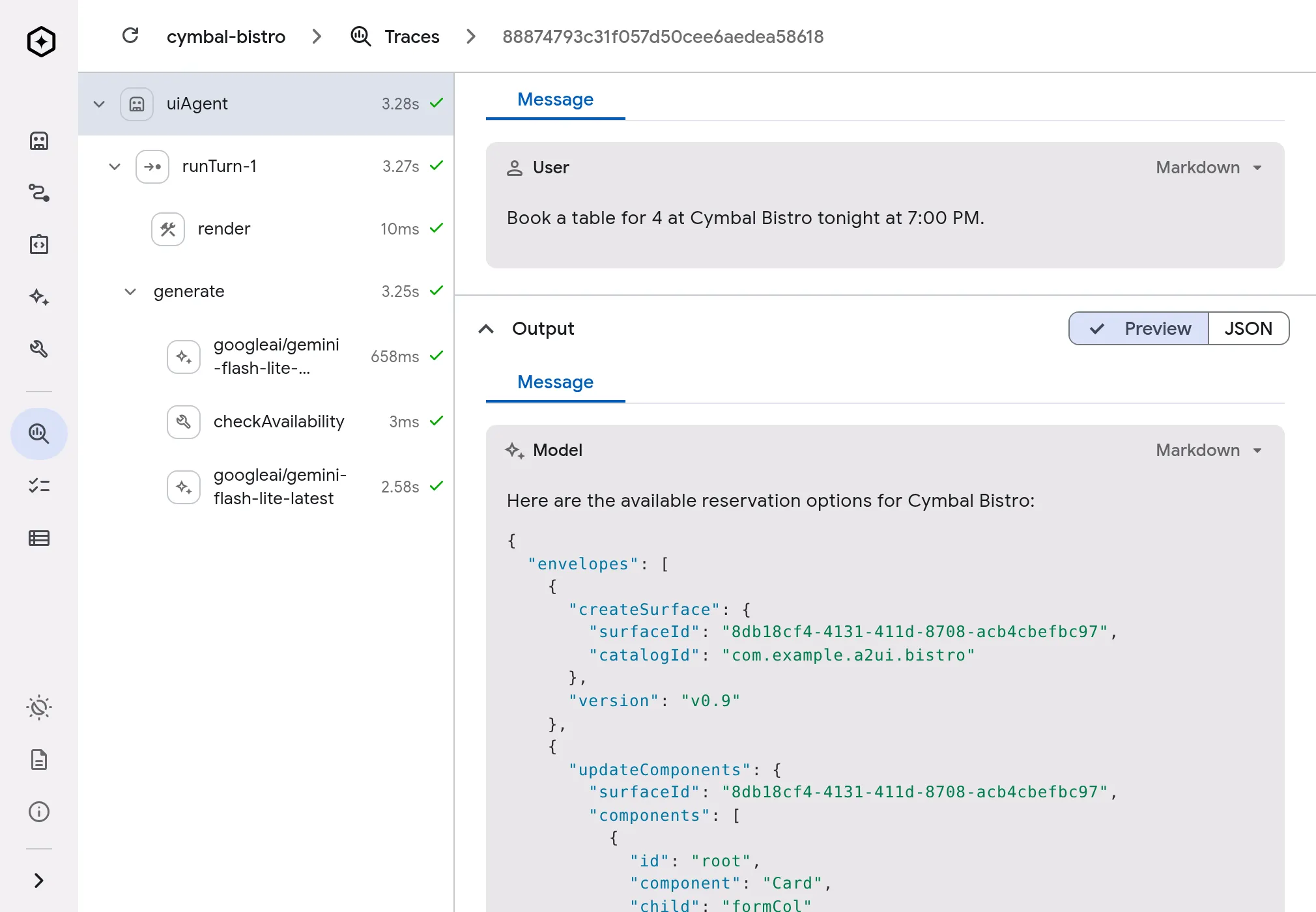
Built for agentic workflows
Section titled “Built for agentic workflows”Since the preview launch, we’ve expanded Genkit Dart with capabilities designed for multi-step agentic workflows, including human-in-the-loop interrupts, generation middleware, prompt management, and production telemetry.
Give models tools with human-in-the-loop interrupts
Section titled “Give models tools with human-in-the-loop interrupts”Tools let models call your Dart functions to fetch data or trigger actions, like searching for flights or booking a hotel. When an action requires user confirmation, a tool can pause the generation loop by returning .interrupt(...) instead of .response(...):
final bookHotel = ai.defineTool( name: 'bookHotel', description: 'Books a hotel room for the user.', inputSchema: HotelBooking.$schema, fn: (input, ctx) async { // Ask the user to confirm before charging their card. if (ctx.resumed == null) { return .interrupt({'hotel': input.hotelName, 'total': input.totalPrice}); } final confirmation = await hotels.book(input); return .response(confirmation.id); },);Putting the approval check inside the tool guarantees that the model can’t bypass it. When generate returns with FinishReason.interrupted, your Flutter app can prompt the user for confirmation and resume execution from where it paused.
Extend generation with middleware
Section titled “Extend generation with middleware”Middleware hooks directly into the generate loop to intercept model calls, inject tools, or modify requests and responses. Using genkit and genkit_middleware, you can attach prepackaged middleware like automatic retries, dynamic SKILL.md loading, and tool approval rules to any generate call:
final ai = Genkit(plugins: [googleAI(), SkillsPlugin(), ToolApprovalPlugin()]);
final response = await ai.generate(  model: googleAI.gemini('gemini-flash-latest'),  prompt: 'Move my Kyoto hotel check-in to Friday.',  tools: [findBookings, updateBooking],  use: [    retry(maxRetries: 3),    skills(skillPaths: ['./skills']),    toolApproval(approved: ['findBookings', 'use_skill']),  ],);
You can also author custom middleware with defineGenerateMiddleware for cross-cutting logic like logging, caching, or model fallbacks.
Manage prompts with Dotprompt
Section titled “Manage prompts with Dotprompt”Dotprompt lets you manage prompt templates, model configuration, and input/output schemas together in .prompt files. Genkit automatically loads prompts from your prompts/ directory so you can invoke them as callable functions in Dart:
---model: googleai/gemini-flash-latestinput: schema: destination: string---Write a friendly, two-sentence introduction to {{destination}} for a first-time visitor.final introPrompt = await ai.prompt('destinationIntro');final response = await introPrompt({'destination': 'Kyoto'});Monitor your app in production
Section titled “Monitor your app in production”When you’re ready to deploy, the genkit_otel package exports traces, token usage, and latency metrics using the OpenTelemetry GenAI semantic conventions, integrating directly with your existing observability backend:
import 'package:dartastic_opentelemetry/dartastic_opentelemetry.dart';import 'package:genkit/telemetry.dart';import 'package:genkit_otel/genkit_otel.dart';
await OTel.initialize();configureInstrumentation(GenAiInstrumentation());
What’s next: stateful agents and generative UI
Section titled “What’s next: stateful agents and generative UI”Alongside the stable 1.0 core, we’re developing higher-level agentic APIs under the package:genkit/experimental.dart import so you can try them early and help shape their design.
Stateful agents combine a model, tools, system instructions, and state into a single defineAgent call. Conversations persist across turns and app restarts using session stores, and you can use remoteAgent to delegate tasks to subagents or expose agents over HTTP to connect with your Flutter app:
import 'package:genkit/experimental.dart';
final travelAgent = ai.defineAgent(  name: 'travelAgent',  model: googleAI.gemini('gemini-flash-latest'),  system: 'You help users plan and book trips.',  tools: [searchFlights, bookHotel],  store: FirestoreSessionStore(collection: 'sessions'),);
final chat = travelAgent.chat(sessionId: 'user-123');final response = await chat.send(text: 'Find me a weekend in Lisbon.');
Generative UI with A2UI lets agents stream interactive UI surfaces instead of plain text. With genkit_a2ui, an agent can emit components like date pickers, forms, and confirmation cards that your Flutter app renders incrementally as native widgets. Check out the A2UI guide to learn more.
Get started
Section titled “Get started”Genkit Dart 1.0 is available on pub.dev today. Thank you to everyone in the Dart and Flutter community who built with the preview, reported issues, and contributed pull requests to help bring Genkit Dart to 1.0.
- Get started: Follow the quickstart guide.
- Explore samples: Browse the sample apps on GitHub.
- Join the community: Chat with the team on Discord.
- Stay updated: Follow Genkit on X and LinkedIn.
- Give feedback: Open an issue on the GitHub repository.
We can’t wait to see what you build with Genkit Dart 1.0!